
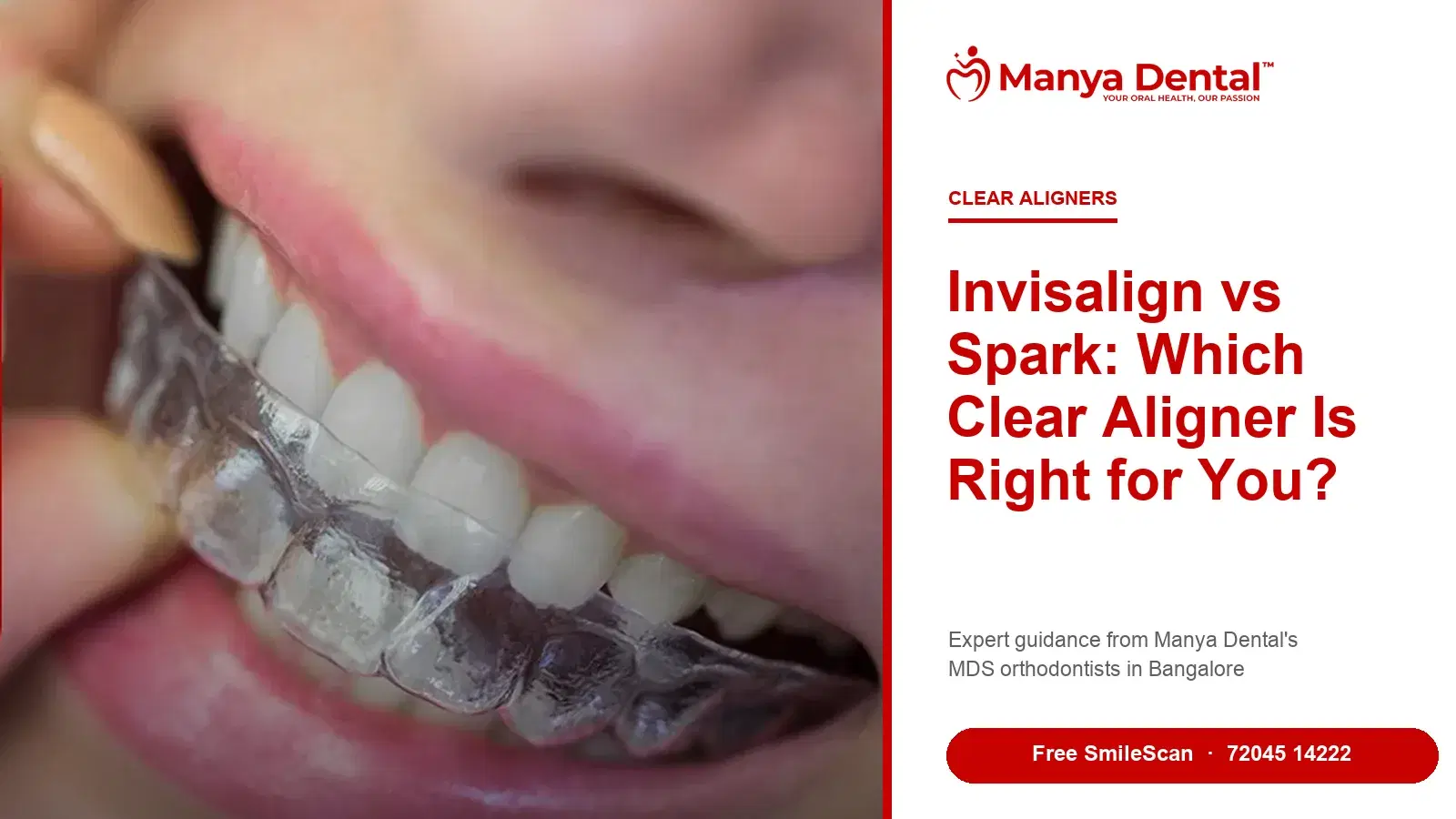
If you are considering clear aligners, Invisalign and Spark are two established systems you may encounter during an orthodontic consultation. Both use a series of custom-made removable trays to move teeth gradually, but they are not identical products. They differ in materials, digital workflows, tray design, and how their manufacturers describe performance.
The key point is that a brand name doesn't determine whether treatment will work for you. Your diagnosis, the movements required, your gum and bone health, the treatment plan created by the orthodontist, and how consistently you wear the aligners all influence the result. Current clinical evidence supports clear aligners particularly well for selected mild-to-moderate malocclusions, while some complex movements remain less predictable than others.
So, the best question is not simply “Is Invisalign better than Spark?” It is: “Which system gives my orthodontist the tools and treatment plan needed for my specific case, at a cost and level of support that I am comfortable with?”
Quick Answer
Invisalign and Spark are both professional, doctor-directed clear aligner systems. Invisalign uses proprietary SmartTrack material and the ClinCheck digital treatment-planning platform. Spark uses proprietary TruGEN and TruGEN XR materials and its own doctor-led digital workflow. Spark's manufacturer emphasizes clarity, polished/scalloped edges, and reduced staining compared with a leading competitor; Invisalign emphasizes SmartTrack, ClinCheck, and SmartForce features.
These manufacturer claims should be interpreted as product-specific claims rather than proof that one brand will produce a better result for every patient. For a patient choosing between the two, the orthodontist's diagnosis and treatment plan should carry more weight than marketing claims about speed, comfort, or appearance.
What Are Invisalign and Spark?
Both systems use a sequence of custom aligners. The orthodontist starts with clinical records and digital models or scans, plans the desired tooth movements using treatment-planning software, and prescribes a sequence of trays. The patient then progresses through the prescribed series while attending follow-up appointments so the clinician can assess tracking and make adjustments or order refinements when necessary.
Orthodontic treatment is not simply a matter of printing plastic trays. The biological response of teeth and supporting tissues varies, and some movements are inherently more difficult to achieve predictably. A 2026 systematic review found mixed evidence when comparing clear aligners with fixed appliances for specific anterior-tooth movements, with fixed appliances showing an advantage for some rotation and torque outcomes in the limited evidence available.
Invisalign: What Makes It Different?
Invisalign is an established clear aligner system developed by Align Technology. Its aligners are made from proprietary SmartTrack material, and treatment is planned through ClinCheck software. The manufacturer describes SmartTrack as engineered to provide controlled force and a close fit, while ClinCheck allows the doctor to customize and visualize the planned sequence of tooth movements.
Invisalign can also use SmartForce attachments. These are small tooth-colored features placed on selected teeth to give the aligner additional surfaces against which to apply forces. Not every patient requires attachments; their use depends on the prescribed tooth movements.
Spark: What Makes It Different?
Spark Clear Aligners are manufactured by Ormco and use proprietary TruGEN and TruGEN XR materials. Spark's current India materials describe TruGEN as designed for sustained force retention, clarity, comfort, and reduced staining compared with a leading aligner competitor. TruGEN XR is described as the more rigid of the two material options and can be selected by the treating doctor for situations where additional rigidity may be useful.
Spark also uses a doctor-led digital workflow. Its official FAQ states that Spark aligners are custom-designed from a patient's 3D scan and treatment plan using Spark's Approval software, followed by manufacturing of the custom trays.
Key System Differences
-
SmartTrack vs TruGEN/TruGEN XR: proprietary materials with different manufacturer specifications.
-
ClinCheck vs Spark Approval: different digital treatment-planning ecosystems.
-
Spark emphasizes optical clarity and reduced staining in its manufacturer comparisons; Invisalign emphasizes SmartTrack, fit, and controlled force.
-
Both are doctor-directed systems; neither software nor material replaces clinical diagnosis.
-
Neither brand can guarantee a specific treatment duration or outcome for every patient.
1. SmartTrack vs TruGEN: Does Material Matter?
Material is one of the clearest technical differences. Invisalign uses SmartTrack, while Spark uses TruGEN and TruGEN XR. Both manufacturers describe their proprietary materials in terms of force delivery, fit, comfort, and treatment performance.
However, a different polymer does not automatically mean faster or more predictable tooth movement. Clinical outcomes also depend on case selection, treatment planning, biomechanics, attachments, wear time, monitoring, and biological response.
Spark's manufacturer reports that TruGEN is clearer and stains less than its leading competitor. Invisalign's manufacturer presents SmartTrack as engineered for fit, comfort, and controlled force. These are manufacturer-specific comparisons, not a universal clinical ranking.
2. Clarity and Appearance
If appearance is your main concern, Spark is often discussed because its manufacturer places particular emphasis on optical clarity. Invisalign is also designed to be discreet and uses a relatively matte material appearance.
In real life, appearance is affected by more than the polymer itself. Plaque, food and drink exposure, cleaning habits, attachments, and tray fit can all affect how visible an aligner looks.
It is reasonable to prefer Spark if optical clarity is especially important to you, but it would be inappropriate to promise that Spark will be invisible or that Invisalign will be noticeably more visible for every patient.
3. Comfort and Edge Design
Spark specifically describes its aligners as having polished, scalloped edges. Invisalign aligners are custom-trimmed to the patient's gumline and are designed for a close fit. Comfort is therefore influenced by both material and tray design.
A new aligner can cause pressure or mild tenderness as teeth begin responding to the new stage. Persistent or significant pain should be discussed with the treating clinician.
4. ClinCheck vs Spark Approval
Both systems use proprietary digital planning tools. Invisalign uses ClinCheck, while Spark uses Approval. These platforms allow clinicians to work with digital records and create a proposed sequence of tooth movements.
A digital simulation is useful for communication and planning, but it is not a guarantee of the final result. Actual biological response can differ from the virtual plan, which is why clinical monitoring and, when necessary, refinements are important.
A 2025 pilot study comparing virtual treatment setups from several aligner companies, including Invisalign and Spark, found differences among systems in the number of aligners, number of attachments, and some planned relationships. This supports an important practical point: different software systems can produce different proposed treatment setups for the same patient.
5. Which Is Better for Complex Cases?
Neither Invisalign nor Spark should be marketed as universally superior for complex orthodontic cases. Clear aligners can manage many orthodontic problems, but predictability varies by movement.
Systematic reviews support clear aligners as an effective alternative for many mild-to-moderate malocclusions, while severe cases and certain movements can have less predictable outcomes. Recent evidence continues to show variability in movements such as rotation, torque, expansion, extrusion, and root control.
6. Can Spark or Invisalign Be Faster?
Do not choose a brand solely because an advertisement suggests faster treatment. Spark's manufacturer describes its material as designed for efficient tooth movement, and Invisalign's system is also engineered around controlled tooth movement. But total treatment time depends on diagnosis, movement complexity, biology, compliance, treatment plan, and refinements.
Two patients using the same brand can therefore have very different treatment durations.
7. Invisalign vs Spark Cost in India and Bangalore
There is no clinically meaningful single national price for either Invisalign or Spark. The final treatment fee can vary according to case complexity, number and type of aligners, diagnostics, orthodontist fees, refinements, retainers, clinic location, and what is included.
For that reason, this article does not publish an invented “average” or a fixed Invisalign-versus-Spark price difference for Manya Dental. If you are comparing quotes, ask for the total treatment cost and a written list of inclusions rather than comparing only the starting price.
8. How to Choose Between Invisalign and Spark
Consider Invisalign if your orthodontist recommends it because its digital workflow, SmartTrack material, and system features fit the movements required in your case.
Consider Spark if your orthodontist recommends it and you place particular value on Spark's material characteristics, including its manufacturer-reported optical clarity and reduced staining compared with its named competitor.
If both systems are clinically appropriate, provider experience, treatment plan, monitoring, total package cost, refinement policy, and confidence in the clinician can reasonably influence the final decision.
What to Ask Your Orthodontist Before Choosing
-
What is my exact orthodontic diagnosis?
-
Which movements are most difficult in my case?
-
Why are you recommending Invisalign or Spark for me?
-
How many aligners are expected in the initial plan?
-
Will I need attachments, elastics, or interproximal reduction?
-
How often will my progress be reviewed?
-
What happens if a tooth does not track as planned?
-
Are refinements included in the quoted fee?
-
Are retainers included after active treatment?
-
What is the complete treatment cost, including diagnostics and follow-up care?
Clear Aligner Treatment at Manya Dental
Manya Dental currently lists clear aligners among its orthodontic services and operates eight clinics across Bangalore: Jayanagar, Malleshwaram, Bannerghatta Road, Yelenahalli, Hongasandra, Chandapura, Haralur, and Kadubeesanahalli. Its public clear-aligner information describes digitally planned treatment and 3D simulation, while the clinic network promotes transparent treatment planning and financing options.
For a patient comparing Invisalign and Spark, the useful next step is an orthodontic assessment. The clinician can determine whether clear aligners are appropriate, which movements are required, and which available system best fits the treatment plan.
Manya Dental's public contact information lists the central helpline as 72045 14222. Patients should confirm current package pricing, specific brand availability, and payment terms directly with the clinic before treatment.
Frequently Asked Questions
Is Invisalign better than Spark?
Not universally. Both are established clear aligner systems, and the better choice depends on diagnosis, planned movements, clinician approach, and patient priorities.
Is Spark clearer than Invisalign?
Spark's manufacturer reports greater optical clarity than a named leading competitor. Invisalign is also designed to be discreet. Actual visibility varies with fit, attachments, hygiene, lighting, and individual circumstances.
Is Spark faster than Invisalign?
You should not assume that. Spark's manufacturer describes TruGEN as designed for efficient tooth movement, but individual treatment time depends on case complexity, planning, biology, compliance, and refinements.
Does Spark stain less than Invisalign?
Spark's manufacturer reports less staining than its leading competitor. This is a manufacturer comparison, not a guarantee that a patient's aligners will never stain.
Can both Invisalign and Spark treat overbite or crossbite?
Both systems can be used for a range of malocclusions, but suitability depends on severity and mechanics required. An orthodontist should assess the case.
How many hours should I wear clear aligners?
Most plans require near full-time wear, commonly around 20–22 hours per day, with removal for eating, drinking beverages other than plain water, and oral hygiene. Follow your orthodontist's schedule.
Are refinements normal?
They can be. Teeth may not track exactly as predicted, and additional aligners may be prescribed. Ask whether refinements are included.
How should I compare Invisalign and Spark quotes?
Compare the complete package, not only the starting price: diagnostics, aligner stages, refinements, appointments, attachments, retainers, and financing terms.
Conclusion
Invisalign and Spark are both established options for patients who are suitable candidates for clear aligner therapy. Their proprietary materials and digital systems are different, and Spark places particular emphasis on optical clarity, comfort, and staining resistance, while Invisalign emphasizes SmartTrack, ClinCheck, and a broad digital treatment ecosystem.
The strongest decision-making principle is simple: choose the treatment plan, not just the brand. A careful diagnosis, realistic expectations, professional monitoring, and consistent aligner wear matter more than a promise that one system is universally faster, better, or more comfortable.
Manya Dental Clinics
Specialist at Manya Dental — one of Bangalore's leading multi-specialty dental clinic networks.