
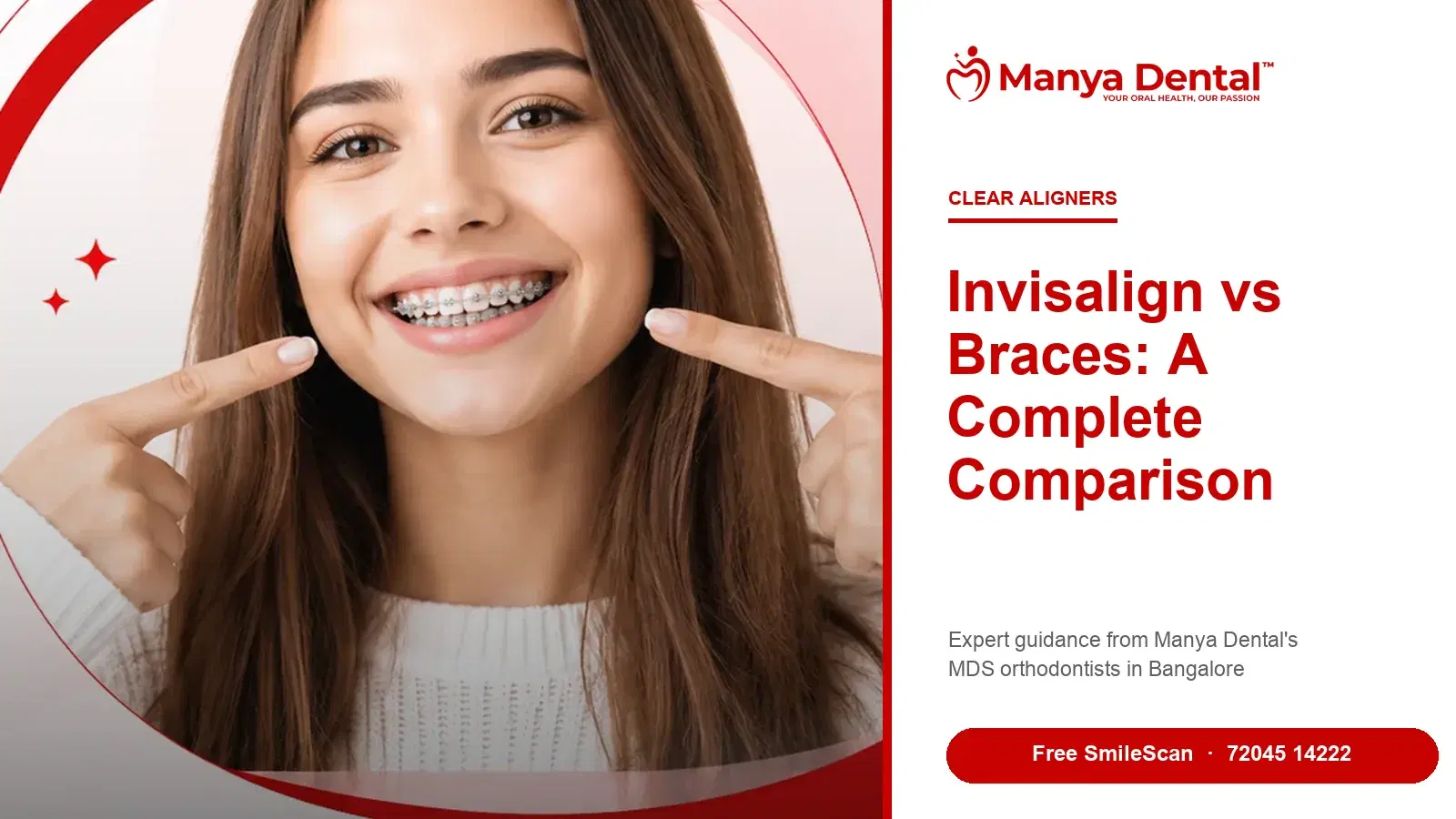
If you are considering orthodontic treatment, two of the most common options you may hear about are clear aligners such as Invisalign and conventional fixed braces. Both are designed to move teeth into healthier positions, but they work differently and place different demands on the patient.
Invisalign uses a sequence of removable, custom-made clear aligners. Fixed braces use brackets attached to the teeth and an archwire, with the orthodontist making adjustments throughout treatment.
Neither option is automatically “better” for every patient. The right treatment depends on your diagnosis, the tooth movements required, your oral health, treatment goals, lifestyle, ability to follow instructions, and the orthodontist's assessment. Recent systematic reviews support both approaches for many patients, while also showing that certain movements and more complex cases may be better controlled with fixed appliances.
How Invisalign and Braces Work
Both treatments use controlled orthodontic forces to change tooth position over time. The difference is how those forces are delivered.
With Invisalign, a digital treatment plan is used to prescribe a sequence of custom aligners. Each aligner is worn according to the orthodontist's schedule before progressing to the next stage. Attachments or other auxiliaries may be used when specific movements require additional control.
With fixed braces, brackets are bonded to the teeth and connected with archwires. The orthodontist changes or adjusts components during scheduled visits to progressively guide tooth movement.
1. Appearance: Which Looks Better?
This is one of Invisalign's clearest advantages for many patients. The trays are designed to be discreet, while conventional metal braces use visible brackets and wires. For adults and professionals who are concerned about the appearance of orthodontic treatment, this difference can be important.
However, clear aligners are not invisible in every situation. Ceramic or tooth-colored fixed braces can also reduce the visual impact of traditional braces.
The practical question is how discreet you need your treatment to be and whether aligners are clinically appropriate for your case.
2. Oral Hygiene: Invisalign vs Braces
One of the strongest practical benefits of removable aligners is access. You can remove the trays to brush and floss normally, then clean the aligners according to your orthodontist's instructions.
Braces require more careful cleaning because brackets and wires create additional areas where plaque can accumulate. This does not mean people with braces cannot maintain good oral hygiene; it means the technique and effort required are different.
A 2026 umbrella review of systematic reviews found consistently better oral-hygiene indicators among clear-aligner patients across the included reviews, although individual behavior and study limitations still matter. Good hygiene remains essential with either treatment.
3. Eating: Which Is Easier?
Invisalign is removable, so you can generally take the trays out before eating and then brush or clean your teeth before replacing them. This means the appliance itself does not impose the same type of food restrictions as fixed braces.
With fixed braces, hard, sticky, and very chewy foods may need to be avoided or modified because they can damage brackets or wires.
Recent systematic-review evidence suggests patients using fixed multibracket appliances experience greater diet-related limitations during the first several months than patients using clear aligners. The certainty of this evidence is not high, but the practical difference is consistent with how the two appliances are used.
4. Comfort and Pain
Neither Invisalign nor braces should be described as completely painless. Both intentionally apply orthodontic forces, so pressure, tenderness, or mild discomfort can occur.
A systematic review and meta-analysis found that clear-aligner patients reported lower pain than fixed-appliance patients at some early time points, particularly around days 3 and 4 after initial treatment, while differences were not consistent at all other time points. Another recent review suggests possible short-term quality-of-life advantages for clear aligners, but the evidence remains limited and heterogeneous.
Comfort also depends on individual anatomy, the specific appliance, adjustments, and how the patient responds.
5. Treatment Effectiveness: Is Invisalign as Effective as Braces?
For many straightforward orthodontic problems, clear aligners can produce effective results. But “effective” does not mean that every tooth movement is equally predictable with both systems.
A 2026 systematic review of adults found mixed evidence across specific anterior-tooth movements. Fixed appliances appeared to have an advantage for some rotation and torque control, while results for other movements were mixed or showed no significant difference.
A 2025 systematic review and meta-analysis found that both clear aligners and fixed appliances effectively achieved orthodontic goals overall, with no significant differences in treatment quality or duration for non-extraction cases. In extraction cases, fixed appliances showed superior treatment quality in the included studies, which the authors associated with greater control of tooth movement.
Therefore, the correct answer is: Invisalign can be as effective as braces for many suitable cases, but it should not be presented as universally equivalent for every orthodontic problem.
6. Which Is Better for Complex Cases?
Case complexity matters more than the marketing label attached to the appliance.
Fixed braces can provide continuous mechanical control and are often useful when the orthodontist needs precise control of difficult movements. Clear aligners can also be used for selected complex cases, sometimes with attachments, elastics, interproximal reduction, or other auxiliaries.
For a patient with significant bite discrepancies, extraction requirements, severe rotations, major vertical corrections, or other complex biomechanics, the orthodontist may recommend braces or a combination of approaches. That decision should be based on the diagnosis rather than the assumption that one appliance is always superior.
7. Treatment Time: Is Invisalign Faster?
Treatment duration varies substantially from patient to patient. It depends on the starting problem, the movements required, treatment mechanics, compliance, biological response, and whether refinements or additional stages are needed.
Some studies and reviews have found shorter treatment times with clear aligners in selected non-extraction cases, while other evidence finds no meaningful overall difference. This is why a clinic should not promise a fixed treatment duration simply because you choose Invisalign.
Ask your orthodontist for a case-specific estimate and ask what could cause treatment to take longer than initially planned.
8. Compliance: The Biggest Difference Patients Often Underestimate
Clear aligners are removable, which is both an advantage and a responsibility. The treatment only works as planned when the patient wears the aligners for the prescribed amount of time and changes them according to the treatment schedule.
Braces are fixed to the teeth, so there is less day-to-day risk of simply forgetting to put the appliance back in. However, braces still require patient cooperation with oral hygiene, food instructions, elastics when prescribed, and scheduled appointments.
If you know that you are unlikely to follow a removable-appliance routine consistently, braces may be a more practical choice even if you prefer the appearance of Invisalign.
9. Cost: Invisalign vs Braces
There is no single price that applies to every Invisalign or braces case in Bangalore. The total cost can vary with case complexity, appliance type, diagnostics, treatment duration, orthodontist fees, refinements, retainers, and what the clinic includes in its package.
Invisalign is generally positioned as a premium clear-aligner option, but the actual quote should be evaluated as a complete treatment package. Braces also have different price levels depending on the type of appliance, such as conventional metal or ceramic brackets.
When comparing prices, ask for a written breakdown rather than choosing the cheapest advertised starting price.
-
Initial consultation and diagnostic records
-
Digital scan or other required imaging
-
Appliance and treatment-planning fees
-
Regular follow-up appointments
-
Refinements or additional stages, where applicable
-
Orthodontic auxiliaries such as elastics
-
Retainers after active treatment
-
Any financing or EMI terms
10. Invisalign vs Braces for Adults
Adults often choose Invisalign because it is discreet and removable, which can make orthodontic treatment easier to integrate with work, travel, meals, and social situations.
Braces remain a strong option for adults when the orthodontic problem requires the control offered by fixed appliances. Age alone does not determine whether Invisalign or braces is appropriate. The condition of the teeth, gums, supporting bone, bite, and treatment goals matter more.
11. What About Manya Dental?
Manya Dental Clinics are certified Invisalign providers offering clear aligner therapy and also provide traditional orthodontic care. Its public clear-aligner information states that its clear-aligner treatment is designed for mild to complex orthodontic cases and uses digital treatment planning with a 3D simulation by senior orthodontists.
Because suitability depends on the individual case, patients comparing Invisalign with braces should have an orthodontic assessment rather than selecting an appliance solely from an online comparison. Manya Dental operates eight clinics across Bangalore, including Jayanagar, Malleshwaram, Bilekahalli, Yelenahalli, Hongasandra, Chandapura, Haralur, and Kadubeesanahalli.
Who May Prefer Invisalign?
-
Patients who strongly value discreet orthodontic treatment.
-
Patients who want to remove the appliance for eating and oral hygiene.
-
Patients who can reliably follow a prescribed wear schedule.
-
Patients whose orthodontic diagnosis is suitable for clear-aligner treatment.
-
Adults or professionals who want less visible orthodontic appliances.
Who May Prefer Fixed Braces?
-
Patients who need stronger control of certain complex tooth movements.
-
Patients whose case involves mechanics that are better managed with a fixed appliance.
-
Patients who may struggle to consistently wear removable aligners.
-
Patients who prefer not to manage removable trays throughout the day.
-
Patients whose orthodontist recommends fixed appliances based on the diagnosis.
Questions to Ask Before Choosing
-
What is my exact orthodontic diagnosis?
-
Which movements are required to correct my bite, not just straighten my front teeth?
-
Is my case predictable with clear aligners?
-
Why are you recommending Invisalign or braces for me?
-
Will I need attachments, elastics, interproximal reduction, or extractions?
-
What treatment duration do you realistically expect?
-
What could make treatment take longer?
-
Are refinements included if I choose aligners?
-
Are retainers included in the total fee?
-
What is the complete cost of treatment and what does it include?
Frequently Asked Questions
Is Invisalign better than braces?
Not for everyone. Invisalign can be an excellent option for many suitable cases, particularly when discretion and removability matter. Fixed braces may provide better control for some complex movements.
Is Invisalign less painful than braces?
Evidence suggests clear aligners may cause less pain at some early time points, but neither treatment is guaranteed to be painless and individual experiences vary.
Can I eat normally with Invisalign?
The trays are normally removed for meals, so the appliance itself does not impose the same food restrictions as fixed braces. Good oral hygiene and following your orthodontist's instructions remain important.
Are braces better for severe cases?
They may be recommended for some severe or complex cases because fixed appliances can provide stronger control of particular movements. The decision depends on the exact diagnosis.
Does Invisalign take less time than braces?
Sometimes, especially in selected non-extraction cases, but not universally. Treatment time depends on the individual case and compliance.
Which is easier to clean?
Removable aligners make access to teeth easier, while braces require more careful brushing and cleaning around brackets and wires.
Can Invisalign fix an overbite?
Clear aligners can be used for some overbite cases, but suitability depends on the severity and underlying cause of the bite problem.
What happens after Invisalign or braces?
Retention is normally required after active orthodontic treatment to help maintain the corrected tooth positions. Your orthodontist will recommend an appropriate retainer plan.
Conclusion
Invisalign and fixed braces are both established orthodontic treatments, but they solve the same problem in different ways. Invisalign offers discretion, removability, and easier access for oral hygiene and eating. Braces provide fixed mechanical control and remain an important option for many complex orthodontic cases.
The best choice is not the appliance with the strongest marketing claim. It is the treatment that can predictably address your diagnosis while fitting your ability to follow the treatment plan.
If you are deciding between Invisalign and braces in Bangalore, start with an orthodontic assessment. Ask what movements are required, why a particular appliance is recommended, how long treatment is expected to take, and exactly what is included in the total cost.
Manya Dental Clinics
Specialist at Manya Dental — one of Bangalore's leading multi-specialty dental clinic networks.