
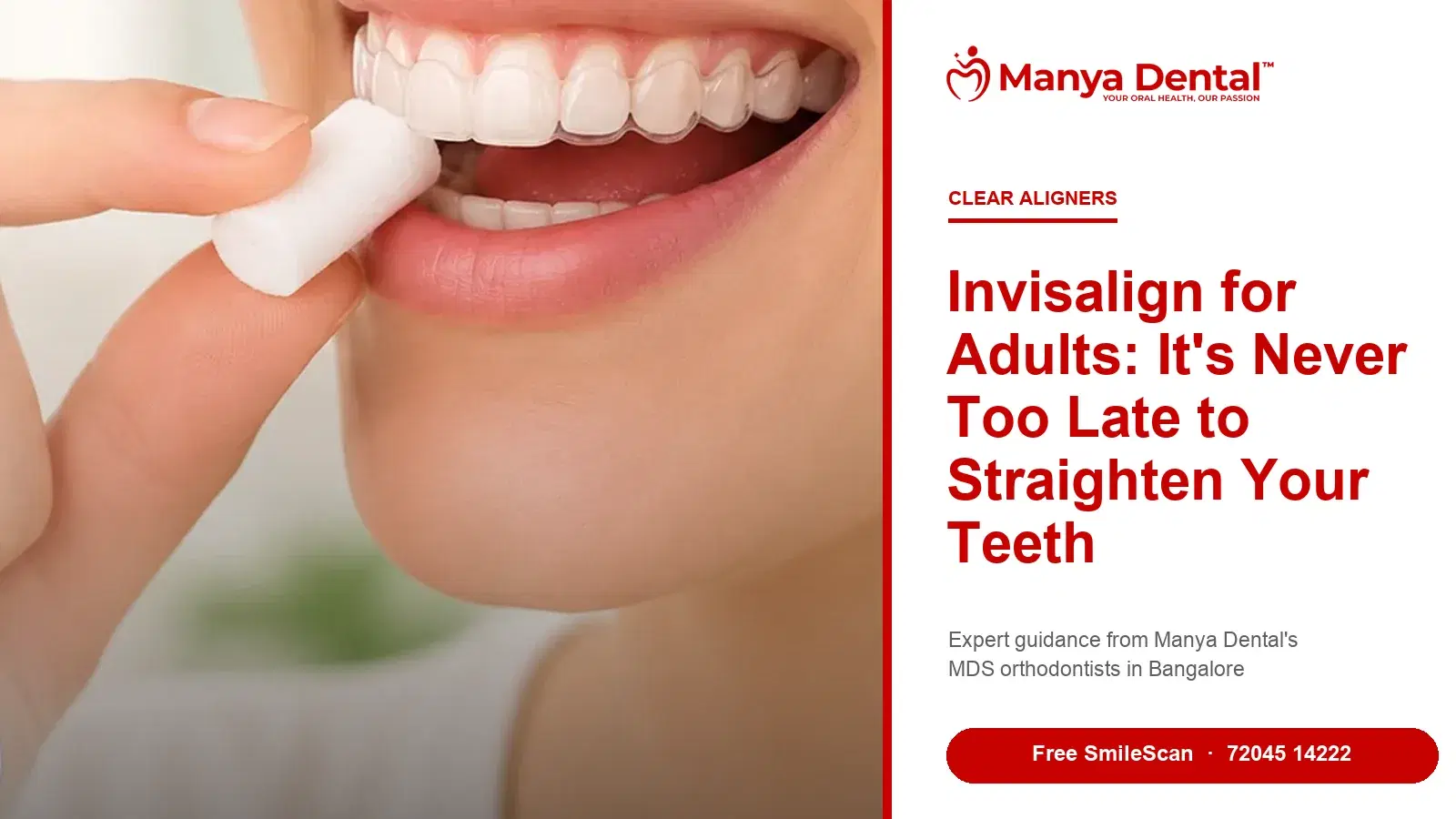
Orthodontic treatment is not only for children and teenagers. Adults can straighten crowded, spaced, or misaligned teeth with clear aligners when an orthodontist determines that aligner therapy is appropriate for the case.
Invisalign can be particularly appealing to adults because the aligners are removable and discreet. That can make treatment easier to fit around work, meetings, travel, meals, and social situations.
But being an adult does not automatically make Invisalign the right choice. Adult orthodontic treatment requires the same basic principle as treatment at any age: the teeth, gums, supporting bone, bite, and required tooth movements must be assessed by an Orthodontist before an appliance is selected.
Quick Answer: Can Adults Get Invisalign?
Yes. Adults can receive Invisalign treatment if they are clinically suitable candidates. Age by itself is not a reason to rule out orthodontic treatment.
What can change with age is the clinical context. Adults may have more mature bone and teeth, previous dental work, gum or periodontal concerns, missing teeth, restorations, or a history of earlier orthodontic treatment. These factors can influence treatment planning.
A 2026 systematic review comparing clear aligners with fixed appliances in adults found mixed results across specific tooth movements. This is important: adult Invisalign can be effective, but the correct appliance depends on the movement required—not simply on the patient's age.
Why More Adults Are Choosing Clear Aligners
-
Discreet appearance compared with conventional metal braces.
-
Removable trays make eating and oral hygiene more convenient.
-
Treatment can be integrated into professional and social routines.
-
Digital planning can help patients visualize the proposed treatment.
-
Clear aligners may offer favorable short-term comfort and quality-of-life experiences for some adults.
Does Age Make Invisalign Less Effective?
Age does not mean that teeth stop responding to orthodontic forces. However, adult treatment can involve factors that are less common in younger patients.
Invisalign's own patient information notes that older adults generally have more mature teeth and greater bone density than younger patients, which can influence how teeth move and may require adjustments to treatment planning.
More importantly, adult suitability depends on oral health and the type of tooth movement required. A systematic review of clear-aligner treatment published in 2025 identified mild-to-moderate malocclusions as the main evidence-supported indication and highlighted limitations for severe malocclusions, impactions, and severe craniofacial skeletal discrepancies.
What Is Different About Orthodontic Treatment for Adults?
| Area | What to consider | What may be assessed |
|---|---|---|
| Gum and periodontal health | Adults may have existing gum inflammation, recession, bone loss, or periodontal disease. | Gum condition, bone support, periodontal status |
| Previous orthodontic treatment | Relapse is common enough that many adult patients have already had braces or aligners. | Previous records, current tooth positions, retention history |
| Dental restorations | Crowns, bridges, implants, fillings, and veneers can affect planning. | Condition and position of restorations |
| Missing teeth | Spaces and tooth replacement plans can change orthodontic objectives. | Space management and restorative plan |
| Bone and tooth maturity | Adult tissues are mature and movement must be planned carefully. | Root position, bone support and movement requirements |
| Compliance | Removable aligners depend heavily on consistent wear. | Ability to maintain prescribed daily wear |
| Lifestyle | Work, travel and social commitments can affect treatment routines. | Appointment schedule and practical treatment preferences |
1. Invisalign for Working Professionals
For working adults, one of the strongest practical advantages of clear aligners is discretion. The trays are designed to be much less noticeable than conventional metal braces, which can be useful during meetings, presentations, interviews, client interactions, and professional events.
Removability also helps around business meals and travel. However, convenience should not be confused with low responsibility: aligners generally need to be worn for most of the day, and repeatedly leaving them out can compromise progress.
Manya Dental currently describes clear aligner treatment as suitable for mild-to-moderate orthodontic cases and recommends 20–22 hours of daily wear, with removal for eating, non-water drinks, brushing, and flossing.
2. Can Adults With Crowded Teeth Get Invisalign?
Crowding is one of the common reasons adults seek orthodontic treatment. Invisalign can be used for many cases of mild-to-moderate crowding, provided the teeth and supporting tissues are healthy and the planned movements are achievable.
More severe crowding may require additional orthodontic mechanics, interproximal reduction, expansion, extractions, or fixed appliances depending on the diagnosis. An adult should therefore not decide on Invisalign simply from a photograph of crowded front teeth.
3. What If You Have an Overbite, Underbite, or Crossbite?
Invisalign can be used for selected bite corrections, but the exact diagnosis matters. A bite problem caused primarily by tooth position may be approached differently from a significant skeletal jaw discrepancy.
The 2025 systematic-review literature supports clear aligners mainly for mild-to-moderate malocclusions and identifies limitations for severe malocclusions and severe skeletal discrepancies. Some adult bite problems may therefore be better managed with fixed appliances, auxiliaries, orthodontic-orthognathic treatment, or another approach.
4. Invisalign After Braces: Can Adults Treat Relapse?
Yes, adults who previously had braces can sometimes use clear aligners for orthodontic relapse. The key question is how much movement is required and whether the teeth and supporting tissues are healthy.
A minor relapse may require a relatively limited sequence of aligners. More substantial relapse can involve bite changes or tooth movements that require a comprehensive orthodontic plan.
Adults should also understand that retainers are important after active treatment. Straightening the teeth again without addressing long-term retention does not eliminate the possibility of future movement.
5. Adults With Crowns, Bridges, or Implants
Previous dental work does not automatically exclude an adult from orthodontic treatment, but it can change the treatment plan.
Natural teeth can be moved orthodontically; dental implants cannot be moved in the same way because an implant is integrated with the surrounding bone. Crowns and other restorations also require the orthodontist to consider how attachments can be placed and how the final tooth positions interact with the restorative plan.
If you have an implant, bridge, crown, veneer, or extensive dental work, tell the orthodontist before treatment planning.
6. Adults With Gum Problems: What Should Happen First?
Healthy supporting tissues are important for safe orthodontic movement. Adults with active gum disease, significant inflammation, or periodontal problems may need dental or periodontal treatment before orthodontic forces are applied.
Do not start aligner treatment simply because the trays are available. The clinician should first determine whether your teeth and supporting tissues are healthy enough for the planned movement.
If you have bleeding gums, persistent swelling, gum recession, loose teeth, or a history of periodontal treatment, mention it during the consultation.
7. How Long Does Invisalign Take for Adults?
There is no single adult Invisalign timeline. Manya Dental currently describes clear-aligner/Invisalign treatment as typically ranging from about 6 to 24 months depending on case complexity, while Invisalign's manufacturer also emphasizes that treatment duration varies by individual case.
A shorter timeline may be possible for limited corrections, while comprehensive bite correction or complex movement can take longer. Refinements can also extend treatment.
Do not choose a provider solely because they promise the shortest timeline. Ask what movements are included in the proposed plan and what happens if the teeth do not track exactly as predicted.
8. How Many Hours a Day Should Adults Wear Invisalign?
Manya Dental recommends wearing its clear aligners for 20–22 hours per day. The trays are removed for eating, drinks other than water, brushing, and flossing.
Because aligners are removable, compliance is one of the most important differences between clear aligners and fixed braces. If you frequently remove the trays for long periods, the teeth may not track as planned and additional treatment may be required.
9. Is Invisalign Comfortable for Adults?
Clear aligners can cause pressure, tightness, or mild tenderness when a new stage is introduced. This is not unusual.
Recent evidence on adult orthodontic treatment suggests that removable aligner patients may experience better short-term oral-health-related quality of life and, at some time points, less pain than patients with fixed appliances. However, the evidence is heterogeneous and does not mean aligner treatment is pain-free.
Significant, persistent, or worsening pain should be discussed with the treating clinician.
10. Does Adult Invisalign Cost More?
Being an adult does not automatically create a separate Invisalign price category. Cost is primarily driven by treatment complexity, duration, provider fees, package inclusions, refinements, diagnostics, and retention.
For patients researching Invisalign cost in Bangalore, a realistic starting point is the official Invisalign India pricing framework: ₹1,50,000 for mild cases to ₹3,50,000 for severe cases. Manya Dental in Bangalore offers Invisalign at ₹1,00,000 for mild cases to ₹3,00,000 for severe cases. These are indicative starting prices for patient education, not fixed clinic prices.
Who Is a Good Adult Invisalign Candidate?
-
Has a mild-to-moderate orthodontic problem that can be addressed predictably with aligners.
-
Has healthy teeth and supporting tissues, or has completed necessary dental/periodontal treatment.
-
Can reliably wear the aligners for the prescribed daily duration.
-
Understands that refinements may be needed.
-
Wants a removable and discreet alternative to fixed braces.
-
Is willing to attend follow-up appointments and follow the orthodontist's instructions.
Who May Need Another Treatment Approach?
-
Patients with severe skeletal jaw discrepancies.
-
Patients with certain severe malocclusions or difficult tooth movements.
-
Patients with active periodontal disease that has not been controlled.
-
Patients who cannot reliably comply with removable-aligner wear.
-
Patients whose dental or restorative situation makes another orthodontic approach more appropriate.
What to Ask Your Orthodontist
-
Is my case suitable for clear aligners, and why?
-
What exact movements are required?
-
Are my gums and supporting bone healthy enough for orthodontic treatment?
-
Do my crowns, bridges, implants, or other dental work affect the plan?
-
How long is the expected treatment, and what could make it longer?
-
How many hours per day do I need to wear the aligners?
-
Will I need attachments, elastics, interproximal reduction, or other auxiliaries?
-
Are refinements included in the treatment fee?
-
What retainer will I need after treatment?
-
How will you monitor my progress?
Invisalign for Adults at Manya Dental
Manya Dental Clinics are certified providers of Invisalign treatment in Bangalore and states that its treatment is digitally planned, with a 3D simulation of the planned result. Its public clear-aligner information says the treatment is intended for mild-to-moderate orthodontic cases and describes 20–22 hours of daily wear, progress check-ups, and retention.
Manya Dental currently lists clear aligners at all of its Bangalore clinics on its dedicated treatment page. For an adult considering Invisalign, the appropriate next step is an orthodontic assessment rather than selecting a treatment based on age alone.
Frequently Asked Questions
Am I too old for Invisalign?
Usually, no. Adults can receive orthodontic treatment when their teeth, supporting tissues, and treatment requirements make it appropriate. Age alone is not a contraindication.
Does Invisalign work for adults as well as teenagers?
Adults can respond well to orthodontic treatment, but adult cases can involve different clinical factors such as mature bone, previous dental work, gum health, and previous orthodontic treatment.
Can Invisalign fix crowded teeth in adults?
It can treat many mild-to-moderate crowding cases. More severe crowding may require additional mechanics or another orthodontic approach.
Can adults with implants use Invisalign?
Possibly, but implants cannot be moved like natural teeth. The implant and surrounding restoration must be considered during treatment planning.
Is Invisalign painful for adults?
Mild pressure or tenderness is common when starting a new aligner. Evidence suggests some adults may experience less short-term pain than fixed-appliance patients, but treatment is not guaranteed to be pain-free.
How long does adult Invisalign treatment take?
It depends on the case. Manya Dental currently describes clear-aligner/Invisalign treatment as approximately 6–24 months depending on complexity, but your orthodontist should provide a case-specific estimate.
Do adults need retainers after Invisalign?
Yes. Retention is generally necessary to help maintain the corrected tooth positions after active orthodontic treatment.
Is Invisalign better than braces for adults?
Not universally. Invisalign may be more convenient and discreet for many adults, while braces can provide advantages for certain complex movements. The diagnosis should determine the treatment choice.
Conclusion
It is not too late to straighten your teeth as an adult. Invisalign can be an effective and discreet orthodontic option for many adults, particularly when the case falls within the range of movements that clear aligners can predictably manage.
The most important adult-specific considerations are not age alone. Your gum and bone health, previous dental work, existing restorations or implants, orthodontic diagnosis, treatment complexity, and ability to wear the aligners consistently all matter.
If you are considering Invisalign in Bangalore, start with a professional orthodontic assessment from reliable and certified providers like Manya Dental. The goal should be to choose the treatment approach that can predictably correct your specific problem—not simply the appliance that looks most convenient.
Manya Dental Clinics
Specialist at Manya Dental — one of Bangalore's leading multi-specialty dental clinic networks.